History of the Large Munsterlander Club in Germany - 100 Years®
1919 - 2019
The Large Munsterlander celebrated its 100th birthday in 2019. A review of the major moments in this breed was prepared by Josef Schmutz in commemoration of this milestone.
1919:
At an 11 February 1919 meeting of owners of black & white long-haired versatile dogs in Haltern, in the Münsterland of northwestern Germany, the assembly agreed on a breed standard for one of the last breeds of versatile dogs to emerge in Germany, the Large Munsterlander. This newly written standard for what was actually a very old breed, was recorded in the corporate registry and is protected to today.
- The original name was Großer Schwarz-weißer Münsterländer. Hunters simply nicknamed the dogs "the Black & Whites", as this colour had not been adopted for any of the versatile breeds at the time.
- Two separate clubs formed to begin promoting the Large Munsterlander. One club was registered in Essen and one in Haltern, merely 50 km apart from one another. Both clubs merged in 1969 to form the Verband Große Münsterländer (VGM) that we know today.
1925:
- The owners' of the Black and Whites first priority was to encourage breeders to strive for a type that could be recognized across the board as a LM. They participated in the many regional single- or all-breed hunting dog clubs for information exchange and for field testing. These regional clubs were gradually united under the Jagdgebrauchshundverband (JGHV) formed in 1899.
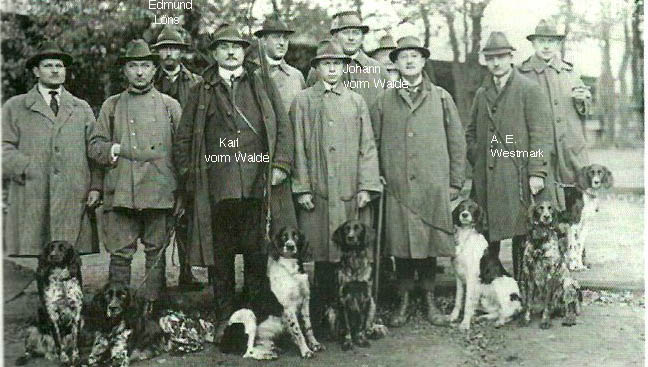
- As a recognizable type began to emerge, LM owners then formulated a hunting test protocol, similar to so many other breed clubs. The first test was held on 24 October 1925. This test became the foundation test for breeders. The accompanying group picture shows seven LMs that are recognizably similar and would fit nicely into any line-up of LMs today.
- The brothers Karl and Johann vorm Walde were staunch supporters of the Large Munsterlander. They are recognized for their commitment by the VGM having named its invitational test, the vorm Walde Herbstzuchtprüfung.
- There are other notable people shown in this group picture. A.E. Westmark was a schoolteacher and bred LMs for decades. Westmark helped form the Haltern club in 1919, and served as secretary in it. The pedigree of the first LM Sheila and I imported in 1972, still showed Westmark’s Karlo as an ancestor, whelped in 1948.
- Westmark was well acquainted with Edmund Löns, a devoted supporter of the Small Munsterlander, who is also shown in the picture. Sigbot (Bodo) Winterhelt married a daughter of Edmund Löns. Bodo Winterhelt introduced the versatile dog concept to North American hunters when he first emigrated to Canada and later the United States.
|
 |
The Second World War was a difficult time for maintaining the working dog standards set by hunters decades earlier. The breeds’ population sizes declined reducing the breeders’ choices for mates and threatening the health of the populations overall. All German breeds suffered. During the Allied Forces occupation, hunters had to give up their guns. Especially at this critical time, hunters questioned why the German Longhair and the Large Munsterlander were ever separated. The division served neither group well.
1970 and beyond:
- The VGM’s breeding commission took the logical step to reach out to the Verein Deutsch Langhaar and introduced German Longhairs into the LM’s gene pool. From 1967 to 1983, 13 litters resulted from pre-planned pairings between LMs and German Longhairs.
- These “LM-GLP” offspring were recorded in an appendix to the LM registry. This was indicated by the prefix reg. preceding the registration number and year. If the offspring were black, and could pass both a conformation and field test, they could then be bred to the traditional LMs.
- Hip Dysplasia became a challenge. The VGM began to require x-rays and introduced gradual changes to the breeding protocol.
- Initially females with borderline HD could still be bred. Then from 1982 on, females had to be HD-free and later both dam and sire needed to be HD-free.
2018:
- The VGM invited other breeders and breed clubs in other nations to join the VGM in a Weltverband, or World Organization, as other versatile dog breed clubs had done. The goal was to avoid a misrepresentation which the VGM feels threatens the identity of the breed abroad. Members of the Weltverband are asked to agree to breed LMs under the guidelines stated in the original intent of the breed in 1919. This is to say a LM needs to conform to the standard and prove full versatility in the field, in water and in the forest.
- Currently, ten LM clubs have responded to the call to become members of the World Association. The Large Munsterlander Association of Canada (LMAC) has not yet joined.
Many dedicated people applied themselves with forethought and diligence to guide the Large Munsterlander as a first rate hunting dog. The LM gained a reputation not only as a capable hunter but an intelligent dog that responds well to training and living with the family. Among the many people who helped achieve the successes of today was Egon Vornholt. Vornholt also facilitated the import of four dogs to Canada.
- He died in May 2016, at age 90.
- He played many key roles in the development of the LM in Germany over more than 50 years, including as a hunter, breeder, VGM officer and particularly as breed warden.
- He wrote Der Große Münsterländer in 1983 which was updated and reprinted in 2004.
- Vornholt also wrote a 108-page historical summary for the VGM’s 75th Anniversary in 1994.
- In 1980, he wrote a book showing the previously scattered registry records, to keep them from being lost.
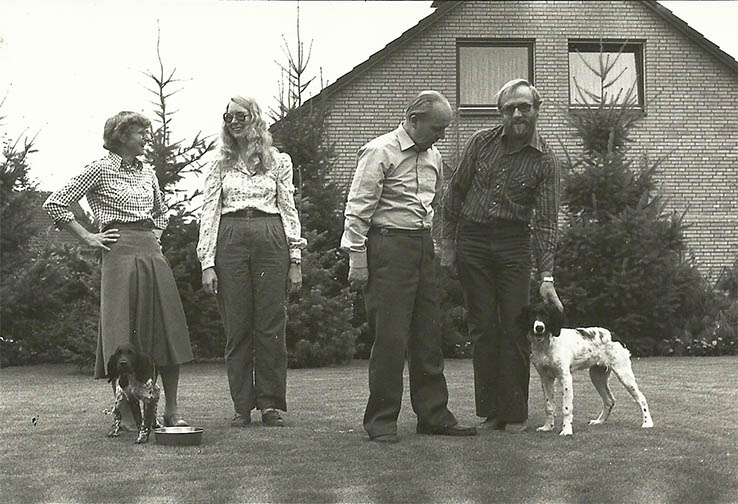 |
The accompanying photograph shows left to right: Anneliese Vornholt and Sheila Schmutz with Caesar vom Mennonitenhof. Caesar was the result of a LM x GLP pairing. Egon Vornholt and Joe Schmutz stand with Bea von St. Vit. Both dogs were selected by Vornholt for us.
|
The successful creation of versatile dogs and a versatile dog culture by the brothers vorm Walde, A.E, Westmark and many, many others is a unique achievement. There is no group of animals on earth that have been so successfully shaped over generations for such a variety and often potentially opposing tasks, as fully versatile dogs do today. It is uncertain what the next hundred years will bring for versatile hunting dogs. For the LM, we can always remember the selfless dedication and achievements of a handful of visionaries and the black & white Longhairs at their sides.
References
- Verband Große Münsterländer e.V. (2019). "100 Jahre Große Münsterländer: Chronik des Verbandes Große Münsterländer e.V." 135 pp.
- Vornholt, E. (1980). "Historisches Zuchtbuch mit Eintragungen des Zuchtjahre 1934-1943." Verband Große Münsterländer e.V., Wilhelm Rehms & Co., Borken, Germany.
- Vornholt, E. (1983). "Große Münsterländer: Praktische Ratschläge für Haltung, Pflege und Erziehung." Verlagsgesellschaft Rudolf Müller GmbH, Köln-Braunsfeld, Germany, 100 pp. Updated version reprinted in 2004.
- Wagner, F. (2019). "JGV Bayern: 100 Jahre im Dienste des Jagdgebrauchshundewesens. Klare Bekenntnisse zum Jagdgebrauchshund aus Leistungszucht, seiner Ausbildung und Prüfung, sowie zur Jagd in Bayern als Kulturgut." Der Jagdgebrauchshund(8): 8-10.
by Joe Schmutz
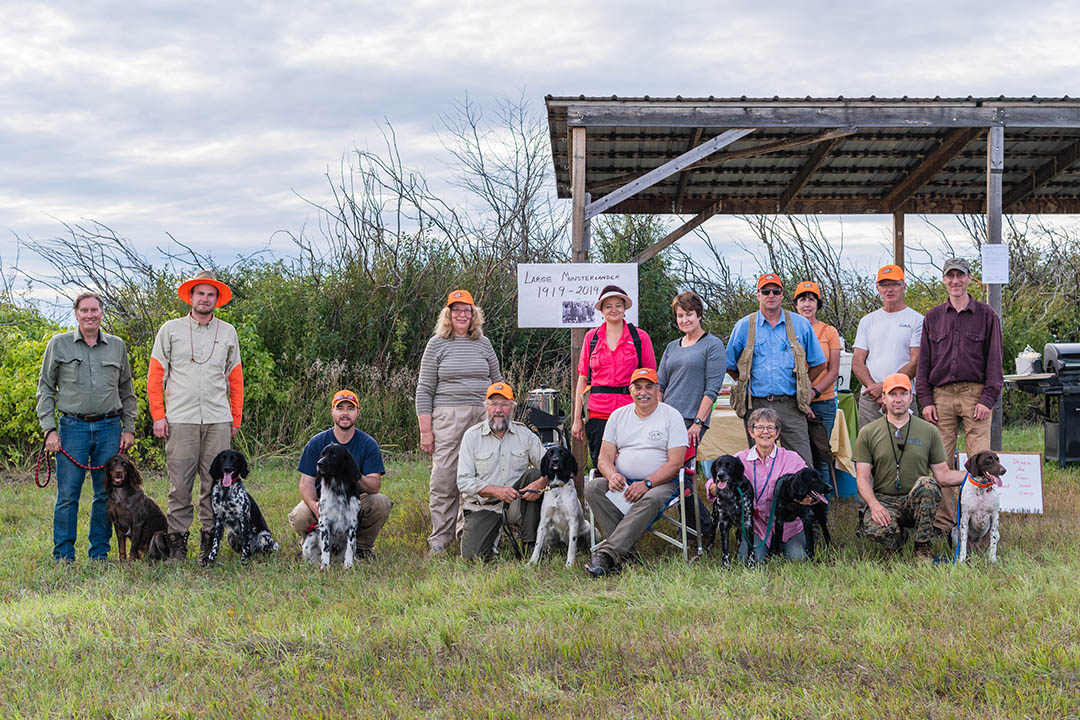
At the 2019 VHDF-Canada test near Alvena, Saskatchewan, participants commemorated the 100-year Anniversary of the Large Munsterlander as a separate breed. Prompted by a picture of LMs and their owners a Century ago, participants reflected on what life was like then, and on the events through time that gave us the dogs we love today.
Please direct general questions about the content of this page to:
e-mail
Back to Homepage
|
 Translate